

US Military Weighs Deploying 'Mother Of All Bombs' Against Iranian Nuclear Sites
The US military is considering deploying its largest non-nuclear weapon against Iranian energy and nuclear infrastructure, though experts question its effectiveness against deeply buried targets.
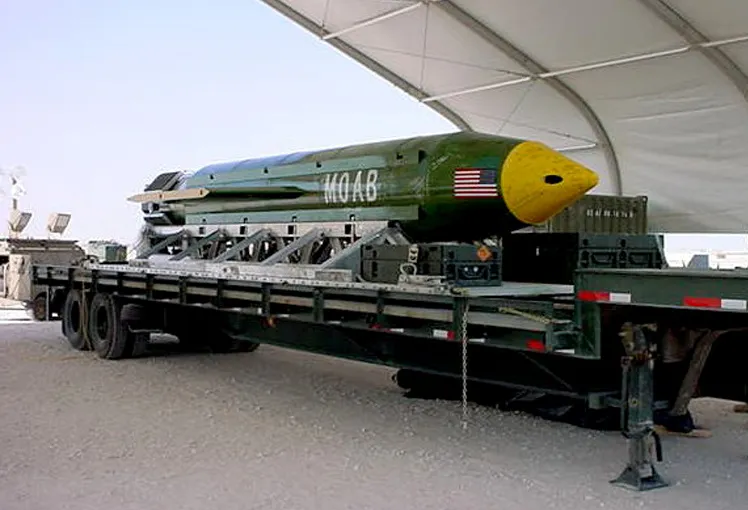
WASHINGTON: The United States military has formulated strike plans that include the potential deployment of the 'mother of all bombs' against Iranian energy infrastructure and nuclear facilities. The proposed use of the GBU-43/B Massive Ordnance Air Blast (MOAB) marks a possible escalation in the ongoing conflict, though internal doubts persist regarding its strategic efficacy.
The deliberations come as President Donald Trump faces mounting domestic pressure to conclude the widely unpopular war ahead of the November midterm elections. Diplomatic efforts to end the fighting, which erupted following US-Israeli strikes in February, remain stalled. Republicans are bracing for potential political backlash from voters due to the conflict and rising fuel prices.
While the administration has explored options to deliver a significant show of force, some officials privately question whether the White House possesses a coherent strategy to definitively end the conflict. White House advisers have held meetings to discuss various options, with some phrasing indicating an attack could occur prior to a US retrograde in the CENTCOM area of responsibility.
The MOAB, weighing 21,600 pounds, is the most powerful non-nuclear bomb in the American arsenal. It is capable of destroying an area equivalent to nine city blocks. However, military planners acknowledge that the GPS-guided munition lacks the capability to penetrate deep underground. Targets such as the Pickaxe Mountain facility, where the US and Israel suspect Tehran stores nuclear components, are believed to be fortified by layers of granite.
'The MOAB is a massive information operation type weapon that is great for huge area clearance but not much else,' a source familiar with the planning told CNN. 'It is definitely not designed as a deep penetration warhead'. President Trump recently clarified the weapon's nature during a Newsmax interview, stating, 'It’s not nuclear at all... I wouldn’t use nuclear, we don’t have to'.
The potential deployment carries significant risks, particularly concerning civilian casualties if the weapon is used near populated areas and non-military sites. Furthermore, using the MOAB may serve more as a psychological tool rather than a militarily decisive one, especially if the primary objective is neutralising deeply buried nuclear sites. The administration could launch the additional strikes, attempt to declare victory and quickly pull troops out.
If authorised, this would not be the weapon's first combat use; Trump previously deployed the MOAB against Islamic State hideouts in Afghanistan in April 2017, killing over 90 militants. As the White House weighs these high-end options, the focus remains on whether a surface-level strike can achieve the strategic victory the administration seeks before voters head to the polls.
Latest



Top stories



Russia News




India Business News



Assam achieves full rail electrification after Lumding hill section completed