



Five Lost Orangutans in Odisha Forest Expose India's Booming Wildlife Trafficking Crisis
BALASORE, Odisha — At approximately 11:25 PM on September 8, 2026, grainy CCTV footage captured a black Thar SUV slipping quietly into the coastal stretch of Badapai village, bordering the Bichitrapur casuarina reserve. Fifteen minutes later, the vehicle departed, leaving behind an extraordinary cargo that would expose the dark underbelly of India's illegal wildlife trade.
 - Editor
Last Updated:
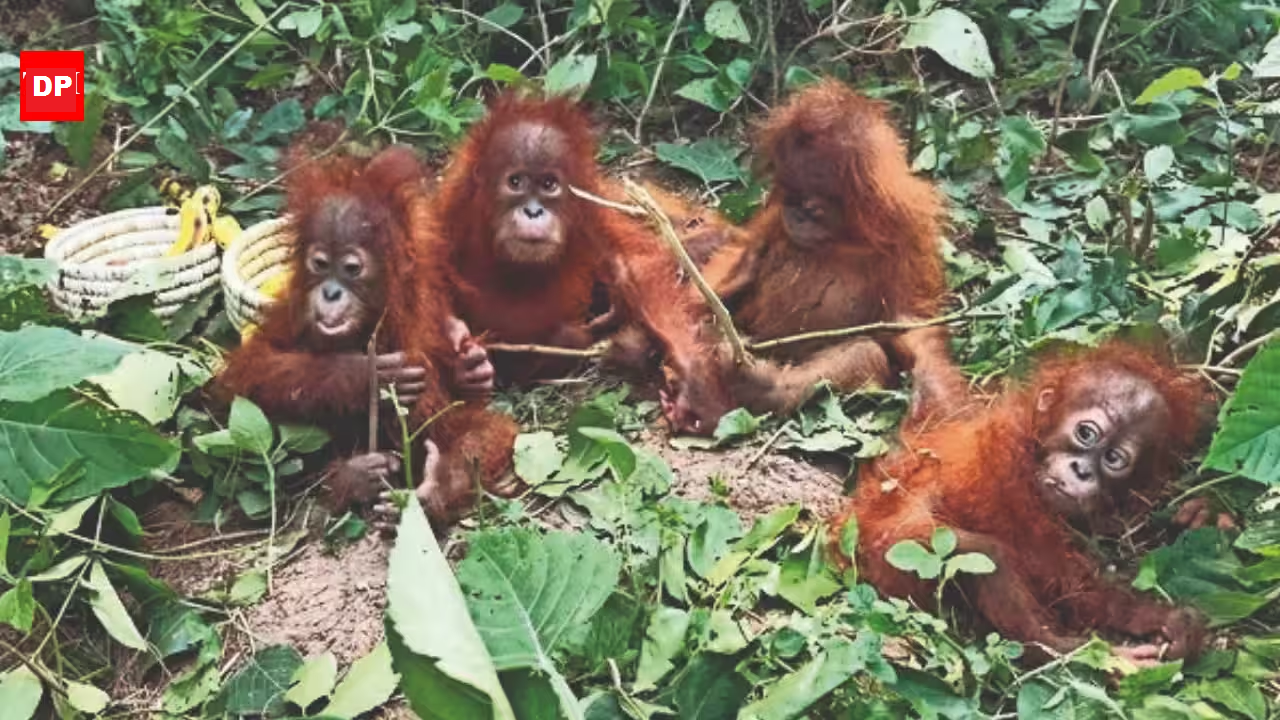
BALASORE, Odisha — At approximately 11:25 PM on September 8, 2026, grainy CCTV footage captured a black Thar SUV slipping quietly into the coastal stretch of Badapai village, bordering the Bichitrapur casuarina reserve.
Fifteen minutes later, the vehicle departed, leaving behind an extraordinary cargo that would expose the dark underbelly of India's illegal wildlife trade.
By dawn on September 9, villagers roaming the Udayapur-Talsari forest area near Bhograi discovered what no Indian forest should contain: five infant orangutans, aged between six months and one year, clinging desperately to casuarina branches.
The Midnight Abandonment
The discovery triggered immediate alarm among forest officials. Orangutans—Asia's only great apes—are native exclusively to the rainforests of Borneo and Sumatra in Southeast Asia, approximately 2,700 kilometers from Balasore.
"Chances of their natural migration to the Balasore forest is less as there is no corridor link. It must be a human-induced act," said Balasore Divisional Forest Officer Pratik Prakash Indalkar.
The animals, three males and two females, were found in remarkably calm condition despite their abandonment. Standing merely 1 to 1.5 feet tall, the juveniles allowed forest personnel to approach and secure them in cages without tranquilizers—a testament to their youth and disorientation.
"We have rescued five baby orangutans and brought them to the forest office. Four of the five babies are healthy and eating food and drinking ORS. Veterinary doctors are examining and treating them," DFO Indalkar confirmed.
The Trafficking Trail
What followed was a multi-agency investigation revealing the scale of India's exotic wildlife crisis. The Wildlife Crime Control Bureau (WCCB), Odisha Police's Special Task Force, and a three-member SP-rank team launched parallel probes into the animals' origin.
Forest Minister Ganesh Ram Singh Khuntia confirmed authorities suspect involvement of an international smuggling racket.
"It appears to be a botched-up transit operation. The orangutans were apparently brought here and subsequently abandoned in the casuarina forest," said Regional Chief Conservator of Forests Prakash Chand Gogineni.
Why Abandon Five Infant Apes?
Wildlife crime experts point to harsh commercial logic. RP Singh, a retired Indian Forest Service officer with over three decades of enforcement experience, explained the likely scenario: a promised buyer backed out at the last minute, turning the animals from valuable cargo into legal liability.
"When an intended buyer retreats or a surprise check-post frightens the couriers, the animals become an immediate burden. The suppliers are merciless—for them, anything that becomes uneconomic is useless," Singh said.
The theory aligns with patterns observed in previous cases. In 2022, five kangaroos were similarly abandoned across West Bengal's Jalpaiguri and Alipurduar districts, carrying forged documents addressed to a municipal zoo in Indore.
India's Dark Transformation
For decades, India served primarily as a source country—poaching tigers, elephants, and rhinos for foreign buyers. That paradigm has inverted. India has quietly become a major consumer hub for exotic species.
"Social media has accelerated this upsurge," explained Dr. Anish Andheria, President and CEO of the Wildlife Conservation Trust. "Making it effortless for a buyer in an Indian metro to connect directly with a foreign seller. When internet users scroll past cute videos of baby primates, they rarely realize they are viewing the public front of a deeply cruel commercial network."
The numbers are staggering. The global illegal wildlife trade is estimated at $8-10 billion annually (approximately ₹75,000-95,000 crore), ranking among the world's largest illicit trades alongside narcotics and arms.
India's domestic illegal exotic pet trade alone accounts for ₹700-900 crore annually—though enforcement agencies typically intercept only 10-20% of illegal consignments.
The Revolving Door of Crime
Crucially, wildlife crime doesn't operate in isolation. Dr. Andheria highlights a documented connection between illegal wildlife trafficking and other transnational syndicates, including human trafficking, money laundering, and drug and weapons trade.
"Criminal networks utilize the same covert transit corridors, forged documentation, and money-laundering channels to move live animals as they do for narcotics or illicit cash," he said.
The Rescue Operation
Back in Balasore, the immediate challenge was securing the orangutans. As crowds gathered—thousands of onlookers arrived within an hour of the discovery—forest officials worked swiftly to prevent stress or injury to the animals.
"The orangutans were extremely calm and meek. They could be handled by hand and placed inside the cage without any difficulty," DFO Indalkar recalled.
Following standard protocol, a team from Nandankanan Zoological Park in Bhubaneswar was deployed to coordinate the transfer. The five infants were transported to the zoo for quarantine and comprehensive medical examination.
"Once shifted, they will be put in quarantine for some days at the zoo," said Principal Chief Conservator of Forests (Wildlife) PK Jha.
A Rare Presence in India
Nandankanan's experience with orangutans is limited. The zoo previously housed Binny, India's only orangutan at the time, who died in February 2019 at age 41 from respiratory issues. Binny had been brought from Pune in 2003, originally arriving from Singapore.
Orangutans can live up to 40 years in the wild and 50-55 years in captivity, meaning these five infants face decades of care—whether in Indian facilities or, potentially, repatriation to their native range.
The Investigation Deepens
Forest officials suspect the orangutans may have arrived via maritime route from Malaysia or Indonesia to Kolkata port, then transported by road to Balasore.
"We suspect they may have come from Malaysia to Kolkata by ship. The WCCB has the expertise to determine the exact species and identify the country of origin," DFO Indalkar said.
The investigation now focuses on:
Tracing the black Thar SUV captured on CCTV
Identifying maritime entry points along the Bay of Bengal
Uncovering the buyer network and financial backers
Determining whether forged documentation facilitated the transport
Legal Framework and Loopholes
India updated its Wildlife (Protection) Act to bring CITES-listed foreign species under domestic law, but enforcement remains fragmented.
Current seizures overwhelmingly target lower-tier couriers—the drivers and transporters—while financial masterminds, middlemen, and wealthy buyers escape scrutiny.
Traffickers exploit loopholes through forged registration papers and false captive-breeding claims, passing off wild-caught foreign animals as locally bred pets.
A Call for Systemic Reform
Dr. Andheria advocates for comprehensive reforms:
Establishing a centralized traceability database for exotic species
Conducting joint interstate investigations
Strengthening cyber surveillance of online wildlife trade
Implementing strict audits of private captive-breeding facilities
Imposing harsher penalties on buyers and financiers
"Until the financial demand at the top of the chain is systematically dismantled, the trade along India's eastern highways will continue to operate in the shadows," he warned.
The Five Orphans
As veterinary teams at Nandankanan monitor the five infant orangutans in quarantine, their presence serves as both a rescue success and a damning indictment.
These critically endangered apes—each species classified in the IUCN Red List's highest risk category—should be thriving in the rainforest canopies of Borneo and Sumatra.
Instead, they became pawns in a multi-crore criminal enterprise, abandoned in a foreign forest when the deal went wrong.
Their survival is assured, at least temporarily. But their story reveals a far darker truth: India's transformation from wildlife source to wildlife destination, enabled by weak enforcement, lucrative profits, and insatiable demand for exotic status symbols.
The Bigger Picture
The Balasore orangutans represent the visible edge of a massive, mostly invisible criminal market.
As investigators trace CCTV footage and maritime routes, the question isn't whether more such cases will emerge—it's whether India's enforcement apparatus can dismantle the networks before more infant apes are abandoned in forests where they don't belong.
Latest


Top stories






Russia News






India Business News





