



Defying the Diktat: Kerala’s Muslim Women Choose Classrooms, Polls, and Onam Over Clerical Confinement
KOCHI — In a state long celebrated for its progressive social indices and inter-cultural harmony, a recent controversy has laid bare the simmering friction between modern aspirations and orthodox orthodoxy. At the center of this storm are Kerala’s Muslim women, who are increasingly asserting their right to public life, only to be met with regressive directives from influential religious clerics.
KOCHI — In a state long celebrated for its progressive social indices and inter-cultural harmony, a recent controversy has laid bare the simmering friction between modern aspirations and orthodox orthodoxy. At the center of this storm are Kerala’s Muslim women, who are increasingly asserting their right to public life, only to be met with regressive directives from influential religious clerics.
The flashpoint emerged following the recent Onam festivities, when prominent Islamic scholar Kanthapuram A.P. Aboobacker Musliyar publicly asserted that women should remain quietly at home.
His remarks extended beyond cultural participation, explicitly opposing co-education and women contesting elections, framing public visibility as incompatible with religious tenets.
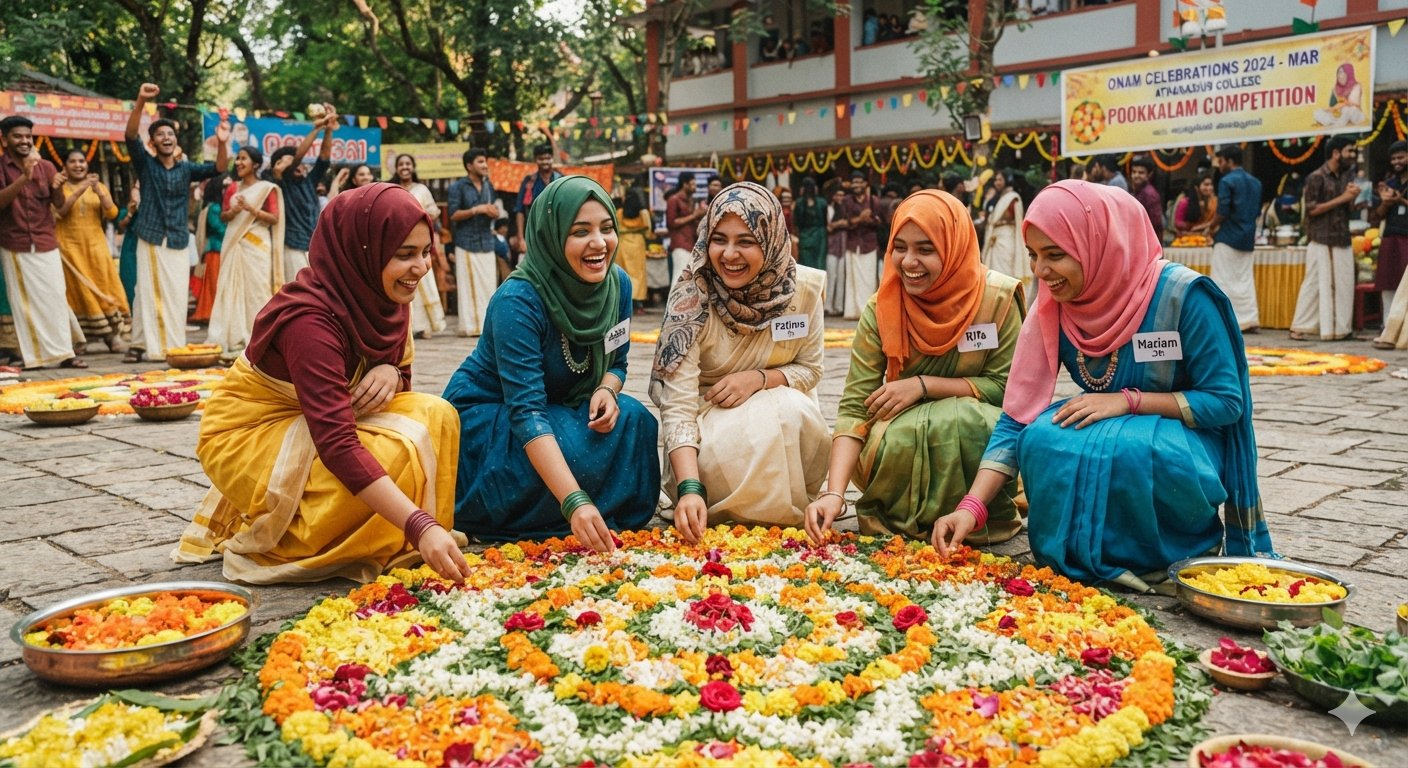
However, the ground reality in Kerala tells a radically different story. Far from retreating, young Muslim women and students across the state enthusiastically participated in Onam celebrations, openly defying fatwas aimed at boycotting the cultural festival.
From college campuses to government offices, their visible presence in traditional attire, joining dance troupes and cultural committees, served as a quiet but powerful rebuke to clerical overreach.
This defiance is not an isolated cultural moment; it is the culmination of decades of steady progress. Building on the legacy of early reformers who championed female literacy, an increasing number of Muslim women in Kerala are breaking barriers in higher education, professional employment, and local governance.
They are doctors, engineers, journalists, and elected representatives, navigating public spaces with an agency that orthodox diktats simply cannot erase.
The political fallout from the cleric’s remarks has been swift and polarizing. The CPI(M) and various women’s rights organizations strongly condemned the statements as an affront to gender equality and the state’s secular fabric.
Conversely, political allies of the cleric attempted to downplay the backlash, defensively framing the comments as a mere "scholarly expression" rather than a binding social mandate.
Yet, this political maneuvering misses the larger sociological shift. The controversy highlights a growing disconnect between institutional religious authority and the lived realities of modern Muslim women in Kerala. When a cleric suggests that women’s achievements should be hidden behind closed doors, he is not just debating theology; he is attempting to roll back decades of hard-won social mobility.
What makes Kerala’s dynamic unique is the community’s internal pushback. Muslim women’s collectives, student unions, and progressive religious voices have been vocal in rejecting these patriarchal interpretations, arguing that faith and public participation are not mutually exclusive.
They recognize that the right to celebrate regional festivals, pursue higher education, and hold political office is fundamental to their identity as both Muslims and Keralites.
Ultimately, the message from Kerala’s Muslim women is unequivocal. They are educated, they are elected, and they are visibly shaping the future of their communities. No fatwa or clerical sermon can mandate their return to the domestic sphere. By choosing classrooms over confinement and cultural solidarity over segregation, they are not just defending their rights—they are redefining them for the next generation.
Latest


Top stories






Russia News






India Business News





