


The ₹500 Note Needs Bhagat Singh’s Fire to Reflect Modern India’s Economic Spirit
NEW DELHI — Currency notes are far more than mere mediums of exchange; they are the most widely circulated canvases of a nation’s identity, history, and aspirations.
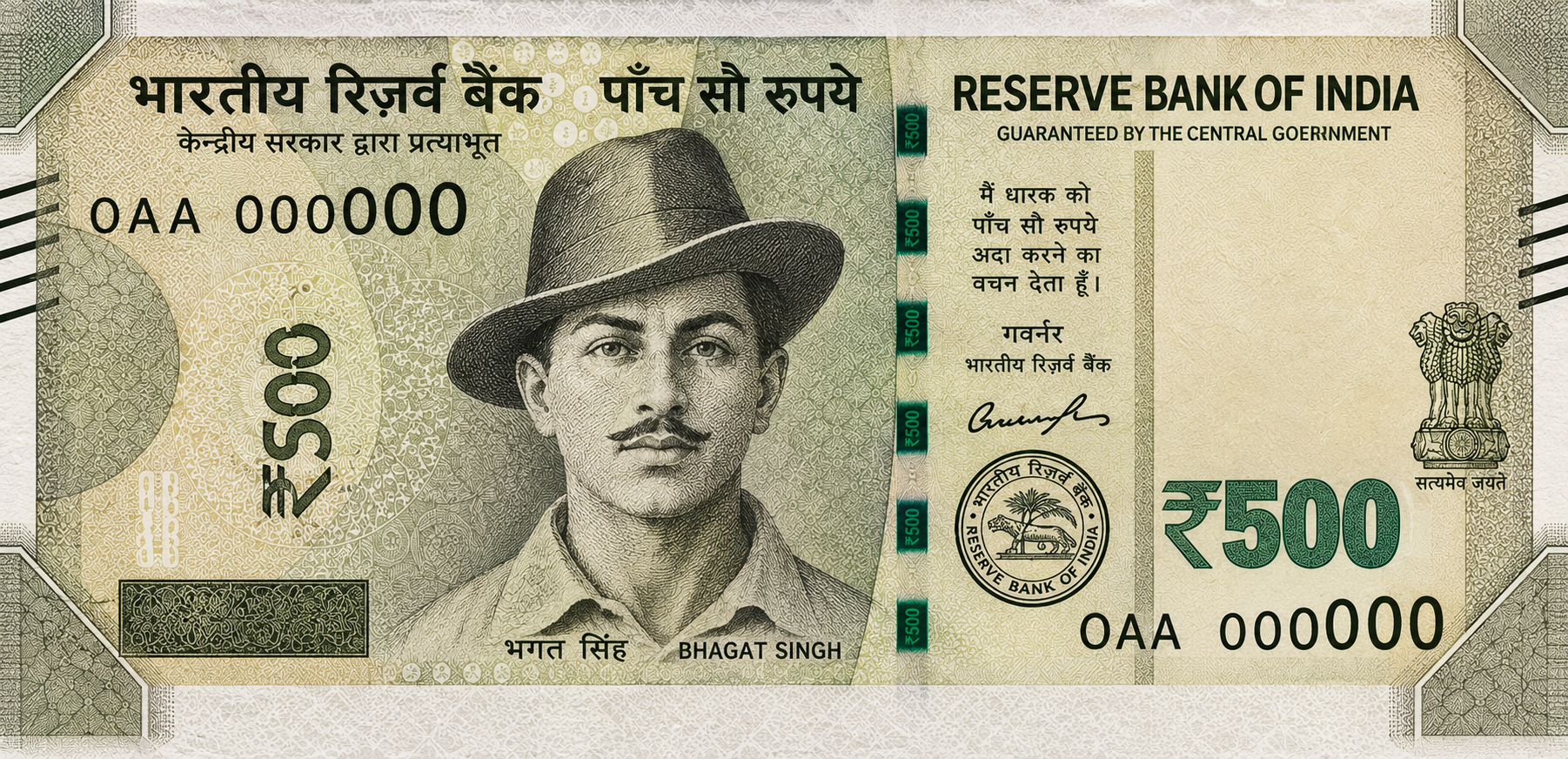
NEW DELHI — Currency notes are far more than mere mediums of exchange; they are the most widely circulated canvases of a nation’s identity, history, and aspirations. For years, the visage of Mahatma Gandhi has graced Indian banknotes, serving as a daily reminder of the moral foundation of our independence. However, as India evolves into a dynamic, youthful, and rapidly modernizing economic power, it is time to reconsider the faces we choose to immortalize on our high-denomination currency. Specifically, replacing Gandhi on the ₹500 note with the fiery revolutionary Bhagat Singh would be a profound, fitting tribute to the spirit of modern India.
To understand why Bhagat Singh is the ideal candidate for the ₹500 note, one must first look at what this specific denomination represents. Reintroduced in the aftermath of the 2016 demonetization, the ₹500 note has become a workhorse of the new Indian economy. It is the note of high-value transactions, digital transitions, and the burgeoning middle class. It symbolizes economic resilience and structural transformation.
Who better to embody this radical transformation than Bhagat Singh?
Often reduced in popular memory to a mere armed revolutionary, Bhagat Singh was, in fact, a profound intellectual and a deep thinker on economics. A voracious reader of global socialist and economic literature, he wrote extensively in publications like Kirti and Inquilab about the exploitation of the peasantry, the agrarian crisis, and the need for economic self-reliance. Placing his face on a high-value economic instrument aligns perfectly with his vision of a prosperous, egalitarian economy free from both colonial subjugation and systemic exploitation. He understood that true independence (Swaraj) was impossible without economic sovereignty.
Furthermore, India today is the youngest major economy in the world. Bhagat Singh was just 23 when he embraced the gallows, yet his intellectual rigor and unyielding courage challenged the might of the British Empire. His image on the ₹500 note—a note that passes through the hands of millions of young entrepreneurs, students, and professionals daily—would serve as a powerful, daily inspiration. It would bridge the historical gap between the sacrifices of our past and the economic ambitions of our youth, reminding them that building a $5 trillion economy requires the same audacity and critical thinking that Bhagat Singh championed.
Critics of this idea often argue that replacing Gandhi diminishes the Father of the Nation’s monumental legacy. This is a false dichotomy. Gandhi’s philosophy of Ahimsa (non-violence) and mass mobilization was the moral bedrock of our freedom struggle. However, the Indian independence movement was never a monolith. The revolutionary stream, spearheaded by Bhagat Singh, Chandrashekhar Azad, and Subhas Chandra Bose, provided the critical, aggressive pressure that accelerated the British exit.
Diversifying our currency to include the revolutionaries on high-value notes does not erase Gandhi; rather, it creates a more holistic, accurate visual history of our freedom. It acknowledges that India was won through a synthesis of moral resistance and revolutionary valor. (It is also worth noting that Gandhi’s face could easily be retained on the lower denomination ₹5 note, ensuring his legacy remains in everyday circulation).
The Reserve Bank of India and the Ministry of Finance have the authority to redesign our banknotes to reflect the changing ethos of the nation. As India marches forward, shedding the last remnants of colonial mindsets and forging a new identity as a global economic powerhouse, our currency should reflect that fire.
Latest



Top stories

Russia News



Live Events