



UPI’s New MDR Framework: 0.4% Fee, ₹300 Cap, and Key Exemptions Explained
NEW DELHI — Starting October 15, 2026, a revised Merchant Discount Rate (MDR) framework will take effect for select Person-to-Merchant (P2M) Unified Payments Interface (UPI) transactions, introducing a nominal charge on digital payments above ₹2,000.
 - Editor
Last Updated:
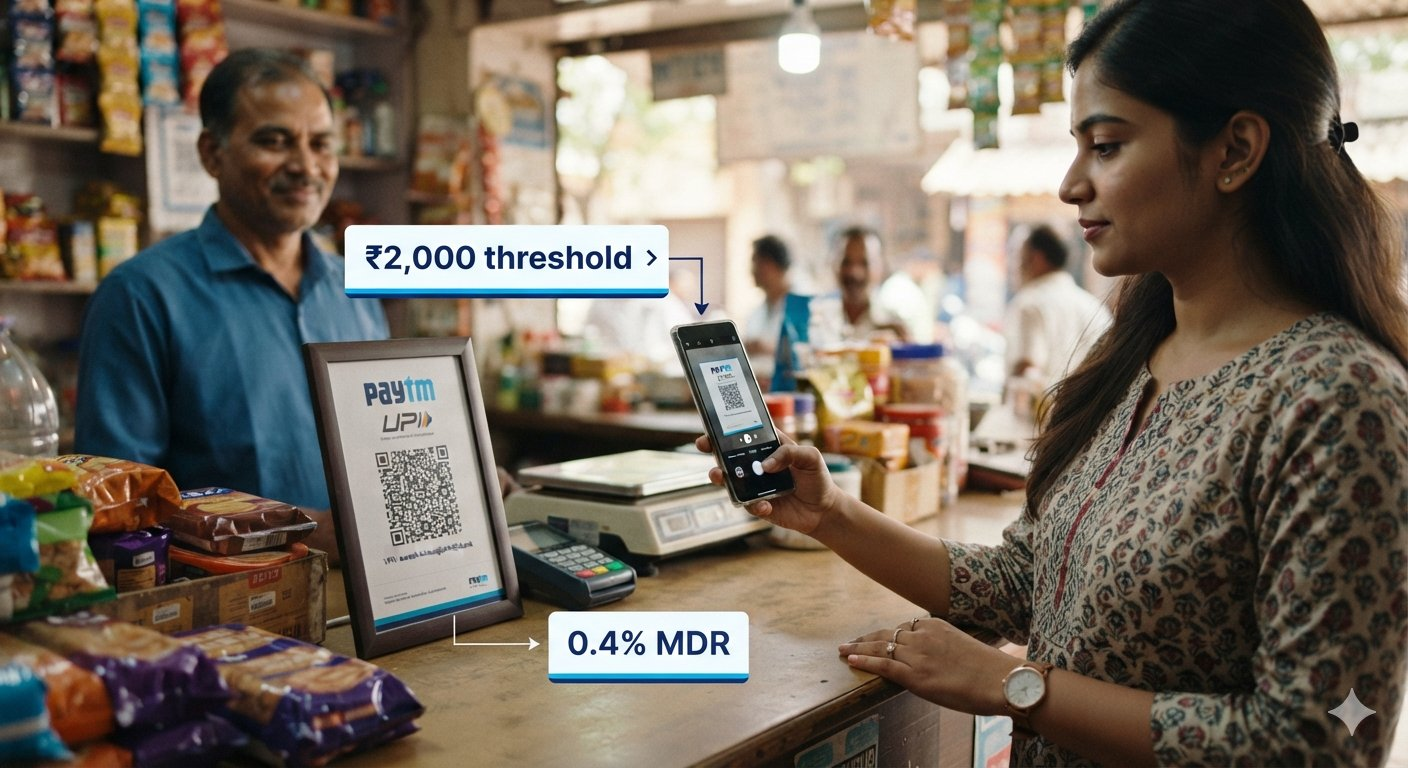
NEW DELHI — Starting October 15, 2026, a revised Merchant Discount Rate (MDR) framework will take effect for select Person-to-Merchant (P2M) Unified Payments Interface (UPI) transactions, introducing a nominal charge on digital payments above ₹2,000.
The National Payments Corporation of India (NPCI) has designed the new structure to balance the financial sustainability of the digital payments ecosystem with the need to keep costs low for end-users and small businesses.
What Remains Free for Consumers
First and foremost, the NPCI has clarified that all Person-to-Person (P2P) UPI transfers will remain completely free of charge.
Furthermore, consumers will not directly pay the new MDR; the fee is strictly levied on the merchant’s side, payable to the acquiring bank or payment service provider.
For everyday small-ticket purchases under ₹2,000, the UPI experience remains exactly as it is today: instant and free.
The New Rate Structure
For transactions exceeding the ₹2,000 threshold, the new MDR framework introduces a tiered pricing model:
Standard Merchant Payments: A standard MDR of 0.4% will apply to eligible P2M transactions above ₹2,000, with a strict upper cap of ₹300 per transaction.
This means a ₹10,000 purchase would attract the maximum ₹300 fee, while a ₹3,000 purchase would incur a ₹12 charge.
Essential Services: To protect consumers from cascading costs on necessities, payments for railways, telecom, insurance, and fuel will attract a flat, nominal MDR of just ₹5 for transactions above ₹2,000.
Capital Markets: Recognizing the high volume and thin margins of investment platforms, mutual funds, stockbrokers, and securities transactions (including Systematic Investment Plans or SIPs) will be charged a highly discounted rate of 0.02%, also capped at ₹300.
Protection for Small Merchants
A critical safeguard in the new policy is the continued exemption for micro and small enterprises.
Merchants whose total UPI QR code receipts do not exceed ₹1 lakh per month will remain entirely exempt from the MDR, ensuring that street vendors, local kirana stores, and small service providers are not burdened by the new compliance costs.
Why the Change Now?
For years, India’s zero-MDR policy on UPI has been a massive success story, driving unprecedented financial inclusion.
However, this model has placed a significant financial strain on banks and payment aggregators, who bear the infrastructure costs of processing billions of transactions monthly.
Industry estimates previously pegged the annual cost of maintaining zero-MDR UPI at over ₹5,500 crore.
The revised framework aims to create a dedicated, sustainable revenue pool to fund network upgrades, enhance cybersecurity, and incentivize payment service providers without making UPI prohibitively expensive.
Even with the new charges, UPI remains vastly more economical for merchants compared to traditional payment methods.
Credit and debit card processing fees typically range from 1.5% to 2.5%, making the capped 0.4% UPI MDR a highly competitive alternative for large retailers.
As the October 15 deadline approaches, businesses are advised to update their point-of-sale systems and inform their accounting teams of the upcoming changes. For the average consumer, however, the core promise of UPI—speed, convenience, and accessibility—remains firmly intact.
Latest




Top stories






Russia News






India Business News

