



ndian Paratroopers Leap Into Indo-Pacific Alliance: 40 Commandos Join 20-Nation War Games in Indonesia
BATURAJA, Indonesia — Forty Indian paratroopers descended upon the tropical forests of South Sumatra this week, joining over 200 airborne commandos from five nations in one of the Indo-Pacific's most ambitious military exercises. The September 4 airborne operation marked a pivotal moment in Super Garuda Shield 2026, Indonesia's largest multinational military exercise, which brought together approximately 6,000 personnel from 15 core participating nations between August 31 and September 11.
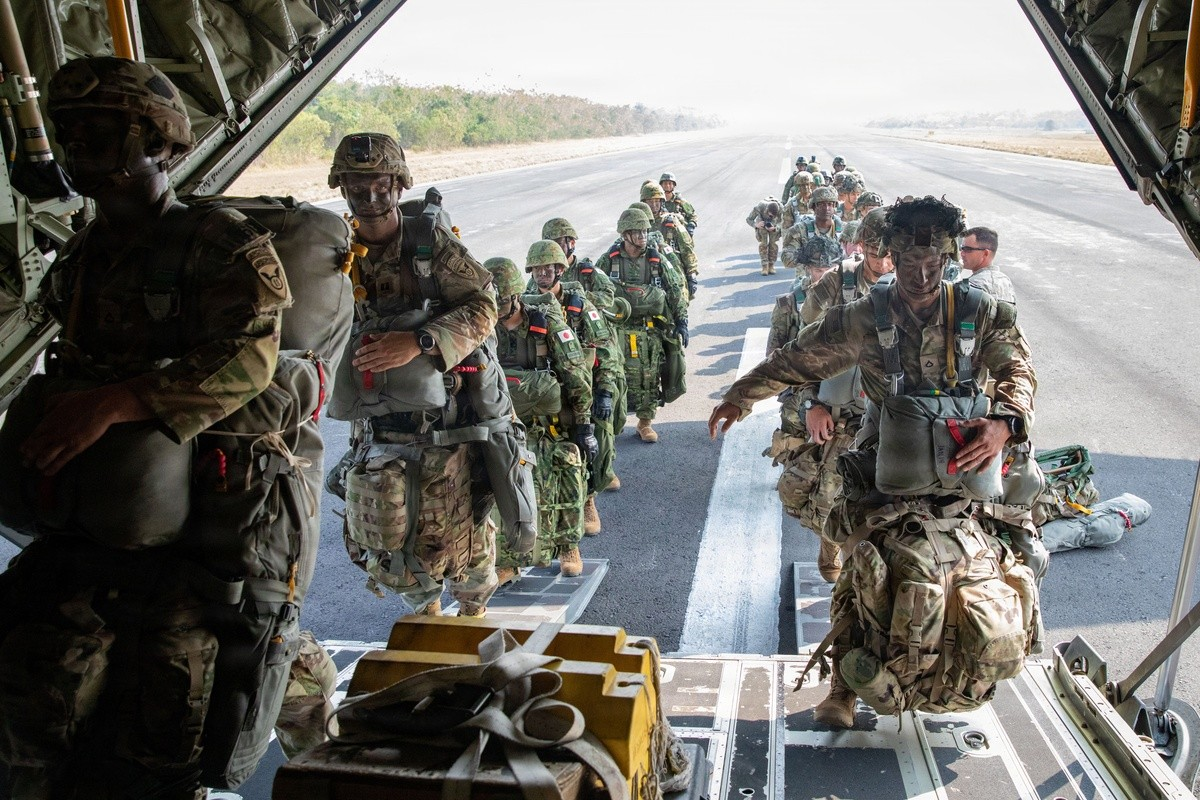
BATURAJA, Indonesia — Forty Indian paratroopers descended upon the tropical forests of South Sumatra this week, joining over 200 airborne commandos from five nations in one of the Indo-Pacific's most ambitious military exercises.
The September 4 airborne operation marked a pivotal moment in Super Garuda Shield 2026, Indonesia's largest multinational military exercise, which brought together approximately 6,000 personnel from 15 core participating nations between August 31 and September 11.
Strategic Jump, Strategic Message
The multinational parachute drop into Baturaja Combat Training Center represented more than tactical training—it signaled India's deepening defense engagement across Southeast Asia. Indian jumpers operated alongside 147 American paratroopers, 17 Japanese personnel, and six French commandos, all launching from C-130 Hercules aircraft at 1,200 feet altitude.
"This exercise demonstrates the United States, Indonesia, and our other partners and allies are in lockstep as we work to safeguard security, prosperity, and sovereignty in the Indo-Pacific," said U.S. Embassy Charge d'Affaires Joy Sakurai during the opening ceremony in Bandung.
From Arctic to Jungle
For U.S. Army Soldiers from the 1st Battalion, 501st Parachute Infantry Regiment based in Alaska, the deployment meant swapping Arctic conditions for South Sumatra's humid tropics. The transition tested their ability to apply common airborne standards across dramatically different environments while integrating with partner-nation procedures.
"Sharing an aircraft with paratroopers from Japan and India made my first overseas airborne operation one to remember," said U.S. Army 1st Lt. Billy A. Mencher, whose unit routinely trains in extreme cold weather conditions.
The same adaptability applied to Indian forces, who demonstrated their capacity to operate in diverse theaters—from Himalayan heights to Southeast Asian jungles.
Multidomain Warfare
Super Garuda Shield 2026 transcends traditional ground exercises. The drill incorporated cyber warfare simulations, amphibious operations, maritime security drills, and joint staff exercises across multiple Indonesian provinces including North Kalimantan, Lampung, and West Java.
"Land, maritime, air and cyberspace operations are no longer conducted independently but are integrated into a single operational framework in which each domain supports the others," explained Indonesian military analyst Jayawibawa, describing the exercise's multidomain concept.
Following the airborne insertion, paratroopers from Indonesia, Japan, Australia, New Zealand, India, Canada, and France organized into Combined Task Force 501, with multinational platoons operating within the same battalion structure before transitioning into intensive jungle warfare training.
Beyond Combat Readiness
While tactical proficiency remained central, Super Garuda Shield emphasized humanitarian assistance and disaster response capabilities—critical skills for Indo-Pacific nations facing frequent natural disasters. The exercise included medical evacuation simulations, civil-military coordination drills, and community engagement activities.
For Indonesia, hosting such a massive exercise serves multiple strategic objectives. "Super Garuda Shield supports TNI modernization and professional development, strengthens Jakarta's defense diplomacy, and improves capabilities," noted Indonesian Defense Ministry analyst Pudji Astuti.
India's Expanding Defense Footprint
India's participation in Super Garuda Shield reflects New Delhi's broader Indo-Pacific strategy, balancing relationships across multiple partners without formal alliance commitments. The exercise coincides with India's ongoing military cooperation with Japan through Exercise Dharma Guardian and regular trilateral drills with the United States and Japan.
Indian paratroopers' involvement in advanced airborne operations demonstrates New Delhi's commitment to maintaining interoperability with key regional players while preserving strategic autonomy.
No Alignment, Only Cooperation
Indonesian officials emphasized that despite the exercise's scale, it doesn't signal alignment with any particular power bloc. "Participation in Super Garuda Shield does not signify alignment with any particular power, nor does it create collective defense obligations with participating countries," Jayawibawa stated, reaffirming Indonesia's "independent and active" foreign policy.
This messaging proves crucial as Southeast Asian nations navigate complex geopolitical pressures between major powers.
Observer Nations Watch Closely
Beyond the 15 core participants—including Australia, Brazil, Cambodia, Canada, Italy, Japan, Laos, Netherlands, New Zealand, South Korea, Singapore, and Timor-Leste—at least 12 observer countries monitored the exercise, including the United Kingdom, Germany, Brunei, Thailand, and Vietnam.
The extensive observer presence indicates growing international interest in Indo-Pacific security architectures and operational interoperability standards.
Testing Rapid Response
The joint airborne training served a specific tactical purpose: enhancing troops' capability to infiltrate enemy lines directly from the air while synchronizing procedures among diverse military forces.
"This activity also served as a vital means for the five countries to synchronize procedures and test their ability to mount immediate joint operations in response to regional crises or contingencies," explained Indonesian military spokesperson Nurdika.
The exercise utilized two Indonesian C-130 Hercules aircraft alongside three U.S. Air Force Hercules transports, with an additional KC-130 tanker supporting extended operations.
Building Confidence, Not Alliances
Regionally, Super Garuda Shield builds confidence among Southeast Asian militaries and supports freedom of navigation across the Indo-Pacific—a principle increasingly tested in disputed waters.
For India, participation strengthens defense diplomacy without formal treaty obligations, maintaining flexibility while demonstrating commitment to regional stability. The exercise provides valuable experience in multinational operations, essential for potential humanitarian missions, disaster relief, or security cooperation scenarios.
Looking Ahead
As Super Garuda Shield concluded on September 11, the exercise established several precedents: India's continued integration into Indo-Pacific security frameworks, the normalization of multinational operations across diverse domains, and the evolution of Indonesia as a key security convenor in Southeast Asia.
The 40 Indian paratroopers who jumped into Baturaja represented more than tactical capability—they embodied India's strategic choice to engage deeply with regional partners while maintaining independent decision-making.
In an era of great power competition, such exercises prove that security cooperation need not mean formal alignment, and that interoperability can strengthen without creating obligations. For India's airborne forces, the tropical jungles of South Sumatra became a classroom for future Indo-Pacific operations.
Latest




Top stories






Russia News






India Business News





