



Nationwide Bank Strike Hits Friday: Branch Services Frozen as Unions Demand Five-Day Week
NEW DELHI — India’s public sector banking network grinds to a halt today, Friday, September 11, 2026, as the United Forum of Bank Unions (UFBU) executes a nationwide strike, triggering a cascading disruption in branch-level financial services. For customers reliant on physical banking, the immediate fallout is severe. Tellers will not process cash withdrawals, cheque clearances will stall, and the evaluation of home, automobile, and gold loan applications stands suspended until further notice.
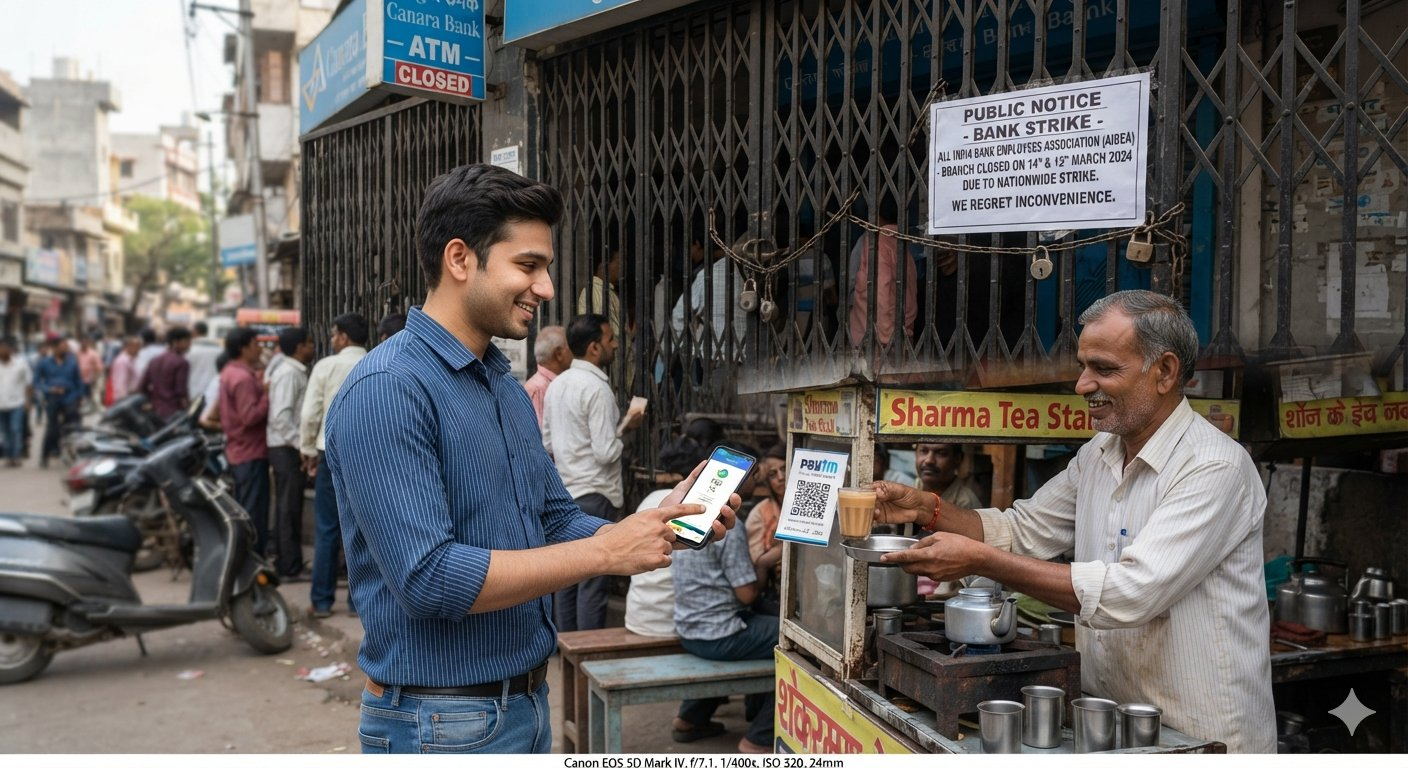
NEW DELHI — India’s public sector banking network grinds to a halt today, Friday, September 11, 2026, as the United Forum of Bank Unions (UFBU) executes a nationwide strike, triggering a cascading disruption in branch-level financial services.
For customers reliant on physical banking, the immediate fallout is severe. Tellers will not process cash withdrawals, cheque clearances will stall, and the evaluation of home, automobile, and gold loan applications stands suspended until further notice.
However, this 24-hour walkout is merely the catalyst for a prolonged operational freeze. Because the strike falls on a Friday, it immediately bridges into the second Saturday holiday, Sunday, and in several states, the Ganesh Chaturthi festival on September 14.
This unfortunate calendar alignment means that critical back-office processing and document verifications will face a minimum 96-hour backlog, disproportionately affecting small businesses and retail borrowers.
At the heart of the agitation is a stalled labor agreement. Union leaders point to a March 2024 settlement wherein bank employees agreed to a 40-minute daily extension in working hours in exchange for a formalized five-day banking workweek.
Despite the Indian Banks’ Association (IBA) recommending this framework, the Finance Ministry has yet to grant final approval, leaving union patience exhausted.
Compounding this frustration is a fierce dispute over compensation structures. The UFBU has vehemently opposed the government’s revised Performance-Linked Incentive (PLI) scheme, labeling it "discriminatory."
Unions argue that the current framework disproportionately rewards a narrow 5% tier of the workforce while neglecting the broader employee base, and they are demanding its immediate withdrawal or bilateral renegotiation.
While the physical doors of public sector banks remain locked, the digital financial infrastructure remains largely insulated. Unified Payments Interface (UPI) transactions, automated teller machines (ATMs), and net banking portals are expected to function without interruption.
Nevertheless, any digital transaction requiring manual backend validation—such as high-value fund transfers, new account activations, or locker access—may experience significant processing delays.
This disruption disproportionately impacts rural and semi-urban demographics, where digital literacy remains a barrier and physical branches serve as the primary node for financial inclusion. For a farmer seeking a Kisan Credit Card renewal or a small trader depositing daily cash receipts, the digital fallback is often not a viable alternative.
Furthermore, the UFBU has signaled that this September 11 action is a warning shot. The coalition has already flagged potential follow-up strikes later in the month, including a proposed three-day nationwide walkout from September 28 to 30, should the Finance Ministry continue to stall on the five-day week and PLI modifications.
This escalating timeline suggests that the current standoff is far from a localized dispute; it is a structural challenge to the administrative approach to public sector bank management.
For the average account holder, the advisory is clear: defer non-urgent branch visits until Tuesday, September 15. For the government, the message is equally unambiguous: unresolved labor grievances will continue to exact a tangible toll on the nation’s financial rhythm.
Latest




Top stories


Russia News






India Business News





