



Modi to BRICS: Move ‘From Files to Real-Life Impact’ as Summit Adopts New Delhi Declaration
NEW DELHI — Prime Minister Narendra Modi concluded the 18th BRICS Summit on Saturday with a clarion call for member nations to transform diplomatic frameworks from bureaucratic documents into tangible, real-world outcomes.
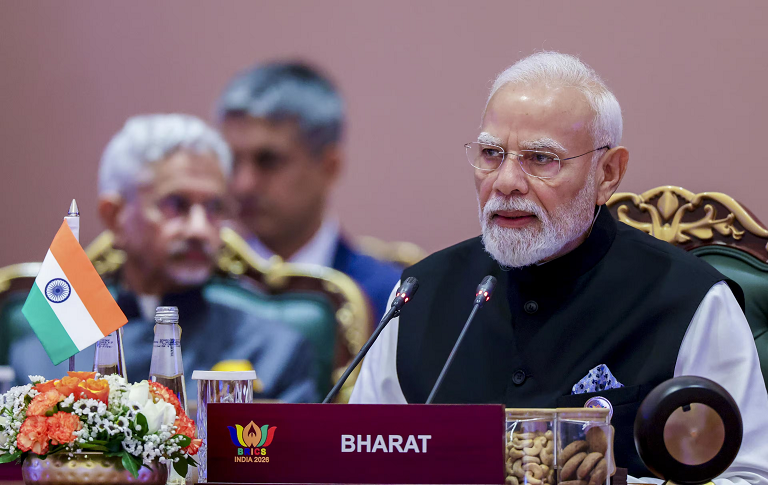
NEW DELHI — Prime Minister Narendra Modi concluded the 18th BRICS Summit on Saturday with a clarion call for member nations to transform diplomatic frameworks from bureaucratic documents into tangible, real-world outcomes.
In his closing remarks at the session on Resilience, Innovation, Cooperation and Sustainability, Modi urged partners to ensure that the summit’s extensive deliberations translate into “time-bound actions that deliver last-mile impact.”
newsonair.gov.in
The Prime Minister’s statement marked a decisive shift in tone, emphasizing accountability over aspiration. “We must translate all outcomes into time-bound actions that deliver last-mile impact,” Modi stated. “We will work together to ensure that our framework moves beyond mere documentation and creates a tangible impact in real life.”
This directive underscores India’s chairmanship theme of “Building for Resilience, Innovation, Cooperation and Sustainability,” which has guided the two-day summit at Bharat Mandapam.
Central to Modi’s address was a redefinition of the bloc’s identity. He asserted that BRICS is “not merely a group of countries, but an ecosystem of solutions,” a phrase that encapsulates the grouping’s evolution from a loose economic forum to a comprehensive platform for addressing global challenges.
The Prime Minister expressed gratitude to the participating leaders, noting that their “important thoughts and suggestions have given both breadth and depth to our cooperation.”
The summit culminated in the unanimous adoption of the New Delhi Declaration 2026, a 140-paragraph consensus document that outlines the collective vision of all BRICS partners.
Modi expressed hope that the declaration would “provide clear direction for our shared vision and future cooperation,” signaling India’s intent to maintain momentum beyond its chairmanship year.
Throughout his address, the Prime Minister highlighted several concrete outcomes from the summit, including the establishment of an Early Warning System for infectious disease prevention, guidelines for disaster management data integration, and a BRICS logistics supply chain cooperation framework.
He also announced the creation of a BRICS network on digital agriculture, aimed at generating new opportunities for farmers across member nations.
However, Modi also issued a stark warning about emerging geopolitical risks, cautioning against the “weaponisation of technology and critical minerals,” which he said could create hurdles for common growth.
He noted that the Global South’s confidence in BRICS has increased, even as rising global tensions continue to negatively impact ordinary citizens.
In his final remarks, Modi extended best wishes to China, the next host of the summit, signaling a smooth transition of leadership. “Friends, BRICS is about to enter its third decade. The world now expects from us not merely ideas and commitments, but concrete results,” he said. “I am confident that, through our collective efforts, we will certainly live up to these expectations.”
As the summit concluded, the focus now shifts to implementation. The Prime Minister’s emphasis on moving “from files to real life impact” sets a clear benchmark for the bloc’s effectiveness in its third decade, challenging member nations to prove that BRICS can deliver more than just diplomatic declarations.
Latest




Top stories


Russia News






India Business News





