



Midnight Diplomacy: How Modi Bridged Iran-UAE Chasm to Forge Unanimous BRICS Declaration
NEW DELHI — In a masterclass of multilateral diplomacy, Prime Minister Narendra Modi successfully navigated deep geopolitical fissures within BRICS to secure a unanimous joint declaration on the escalating Middle East conflict, concluding negotiations that stretched until 4 AM.
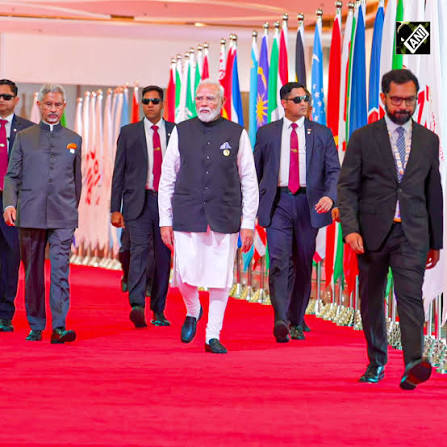
NEW DELHI — In a masterclass of multilateral diplomacy, Prime Minister Narendra Modi successfully navigated deep geopolitical fissures within BRICS to secure a unanimous joint declaration on the escalating Middle East conflict, concluding negotiations that stretched until 4 AM.
The breakthrough came after months of “threadbare” discussions and intense, last-minute compromises between Iran and the United Arab Emirates, two nations with sharply divergent positions on the West Asia crisis.
The 18th BRICS Summit, held at Bharat Mandapam on September 12-13, 2026, witnessed India’s diplomatic machinery working at full throttle to bridge competing positions among the 11-member grouping.
The challenge was particularly acute given the presence of Iran, Saudi Arabia, and the UAE—all members of the same forum despite deep regional rivalries and opposing stances on the ongoing conflict.
The Diplomatic Tightrope
At the heart of the deadlock was a fundamental disagreement over how to address the war. Iran sought strong condemnation of U.S. and Israeli strikes that assassinated its Supreme Leader, mirroring language used in the Shanghai Cooperation Organisation (SCO) declaration.
The UAE, meanwhile, demanded “equal condemnation” of Iran’s retaliatory attacks on its Persian Gulf neighbors.
Indian negotiators, led by Sherpa Sudhakar Dalela, Secretary (Economic Relations) at the Ministry of External Affairs, engaged in delicate, round-the-clock consultations to find middle ground.
The solution emerged through non-specific references to the conflict that allowed both sides to save face while maintaining the bloc’s unity.
The resulting New Delhi Declaration called for “maximum restraint” and urged all parties to avoid actions that “could further aggravate the situation.”
Significantly, the text expressed “deep concern” over attacks on civilian infrastructure and nuclear facilities in West Asia—a clear reference to U.S. and Israeli missile strikes on Iranian soil—without naming specific countries.
A Rare Diplomatic Breakthrough
In a remarkable display of summit diplomacy, Iranian President Masoud Pezeshkian met with Abu Dhabi Crown Prince Khaled bin Mohamed Al Nahyan on the sidelines of the summit at Bharat Mandapam.
This rare direct engagement between Tehran and Abu Dhabi underscored the significance of India’s convening power and its ability to create space for dialogue even among adversaries.
Prime Minister Modi’s personal engagement proved crucial. He held separate consultations with the leaders of Iran, Russia, and the UAE, leveraging India’s strategic autonomy and its balanced relationships across the region.
According to Bloomberg, this achievement represents a significant win for Modi, who has skillfully balanced ties with Iran on one side and the UAE, the United States, and Israel on the other.
Beyond the Middle East
While the Middle East consensus dominated headlines, the New Delhi Declaration addressed a broad spectrum of global issues. The declaration expressed strong criticism of Israel’s bombardment of Gaza, supporting South Africa’s case against Israel in international courts and calling for humanitarian aid to the enclave where over 70,000 civilians are believed to have been killed.
The text dedicated eight paragraphs to Israeli actions, condemning the “forced displacement, temporary or permanent, under any pretext, of any of the Palestinian population from the Occupied Palestinian Territory.”
On economic matters, BRICS nations resolved to increase intra-bloc trade and payments in national currencies, taking aim at U.S. tariffs and Western unilateral sanctions.
The declaration condemned “the imposition of unilateral coercive measures that are contrary to international law,” reflecting the grouping’s broader challenge to Western-dominated global governance structures.
Notably, the declaration made no separate mention of the Russia-Ukraine war, a strategic omission that allowed the bloc to maintain focus on issues where consensus was achievable.
The Indian Sherpa’s Perspective
Sudhakar Dalela, India’s Sherpa at the talks, emphasized that the consensus was built through “months of ‘threadbare’ discussions” and sustained engagement at various levels.
When asked whether India had sought support from other BRICS leaders to convince Iran and the UAE, Dalela diplomatically noted that the cooperation and collaboration of all members was “key.”
“In preparation of the BRICS summit, we have been discussing the Middle East situation (West Asia) for some time,” Dalela explained. “In a grouping where members have diverse experiences, it is important to allow members to have a shared forum, and within that framework to build consensus.”
Strategic Implications
The successful adoption of the New Delhi Declaration marks a significant diplomatic achievement for India as BRICS chair. It demonstrates New Delhi’s capacity to manage complex geopolitical fault lines while advancing the interests of the Global South. The declaration also reinforces BRICS’s evolution from an economic forum into a platform for addressing broader geopolitical challenges.
However, the consensus came at a cost. The non-specific language on the Middle East conflict, while necessary for unanimity, limits the declaration’s practical impact on the ground. Critics argue that such diplomatic formulations, while symbolically important, do little to alter the trajectory of ongoing conflicts.
Yet, for India, the achievement lies in the process itself—proving that even in an era of heightened great power competition and regional fragmentation, dialogue and diplomacy can still yield results. As the BRICS bloc enters its third decade, the New Delhi Declaration serves as both a testament to India’s diplomatic prowess and a reminder of the challenges that lie ahead in transforming consensus into concrete action.
Latest




Top stories


Russia News






India Business News





