
Kyiv Intelligence HQ Struck by Drone as Zelensky Vows Retaliation Amid Internal Security Clash
KYIV — A Russian attack drone struck the central headquarters of Ukraine’s Security Service (SBU) on Thursday, injuring at least twelve people and damaging the historic building situated opposite St. Sophia’s Cathedral. President Volodymyr Zelensky asserted that the unmanned aerial vehicle was specifically aimed at the office of the agency’s acting head, Oleksandr Poklad, characterizing the incident as a deliberate, high-value targeting attempt.
 - Editor
Last Updated:
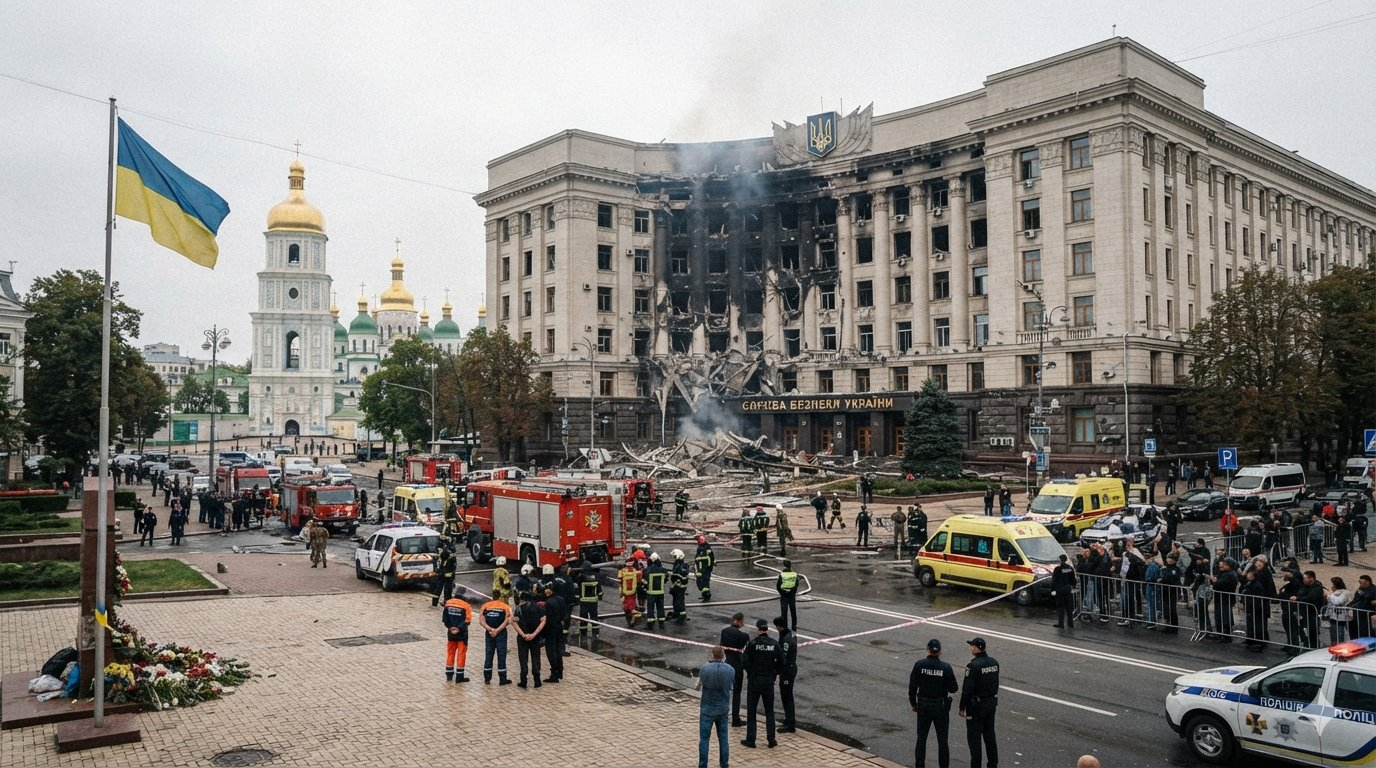
KYIV — A Russian attack drone struck the central headquarters of Ukraine’s Security Service (SBU) on Thursday, injuring at least twelve people and damaging the historic building situated opposite St. Sophia’s Cathedral. President Volodymyr Zelensky asserted that the unmanned aerial vehicle was specifically aimed at the office of the agency’s acting head, Oleksandr Poklad, characterizing the incident as a deliberate, high-value targeting attempt.
While the SBU confirmed the intentional targeting of Poklad’s workspace, officials stated the acting chief emerged entirely unharmed.
The blast shattered the building’s exterior walls and ignited a fire that emergency crews quickly contained. According to the Kyiv City Military Administration, seven of the twelve injured personnel required hospitalization, underscoring the lethal proximity of the strike to the agency's operational core.
In his nightly address, Zelensky framed the incident as a direct provocation demanding a calibrated, state-level response. He announced that he had personally tasked Poklad with devising a "significant and symmetrical" retaliation against Russian targets, noting that the timing of the counterstrike would be strategically withheld for "maximum effect."
However, this external assault arrives at a moment of profound internal vulnerability for Ukraine’s security establishment. Just days prior, the capital witnessed an unprecedented armed confrontation between the SBU and the Main Directorate of Intelligence (HUR), leaving three military intelligence officers wounded in a central Kyiv street firefight.
The intra-agency clash erupted after the SBU detained Stepan Kaplunov, a deputy commander of the Russian Volunteer Corps—a paramilitary unit operationally subordinate to the HUR.
The SBU claimed it was actively thwarting a Federal Security Service (FSB) plot, while HUR operatives accused the domestic agency of an unlawful, daylight kidnapping.
Zelensky has publicly condemned the shootout as an "absolutely disgraceful situation," ordering immediate internal investigations by the State Bureau of Investigation and demanding accountability for all involved.
As a direct consequence of this breakdown in operational discipline, the president swiftly dismissed Oleh Khramov, the head of the SBU’s Department for the Protection of State Secrets.
The juxtaposition of a foreign drone strike on the SBU’s nerve center and a domestic gunfight between rival intelligence factions highlights a fragile moment for Kyiv’s command structure. Military analysts warn that Moscow may be actively exploiting these visible institutional fractures, aiming to destabilize Ukraine’s security apparatus through a combination of external kinetic pressure and internal psychological warfare.
As investigators probe the intelligence shootout and Poklad finalizes his retaliatory blueprint, the Ukrainian leadership faces a dual imperative: projecting unified, uncompromising strength against Russian aggression while forcefully reining in the dangerous, unauthorized rivalries festering within its own ranks.
Latest



Top stories






Russia News






India Business News





