



India-Africa Partnership Holds Immense Potential for Sustainable, Industrial Growth: Naveen Jindal
South Africa, as a gateway to the broader African continent and a fellow BRICS member, remains a pivotal partner in this vision. President Ramaphosa has consistently urged BRICS governments and businesses to deepen cooperation in investment and trade, recognizing that a resilient Global South requires integrated supply chains and shared technological advancements.
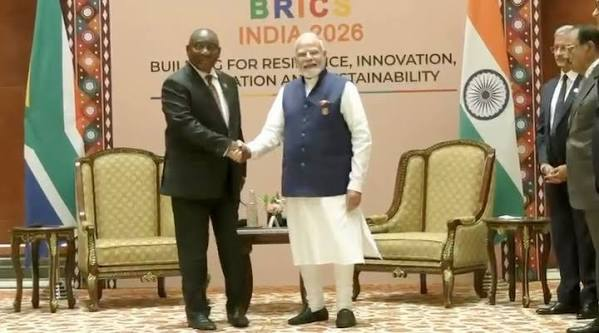
NEW DELHI — The India-Africa partnership is poised to unlock a new era of sustainable industrial development, according to prominent industrialist and Member of Parliament Naveen Jindal, following a high-level meeting with South African President Cyril Ramaphosa on the sidelines of the 18th BRICS Summit.
m.economictimes.com
The engagement, held at the Bharat Mandapam convention center, underscored the critical role of private-sector leadership in advancing the geopolitical and economic objectives of the Global South. Jindal, Chairman of the Jindal Group, described the discussions as highly productive, emphasizing that the shared values and complementary strengths of the two nations provide a robust foundation for long-term strategic investments.
"The partnership between our two nations holds immense potential for sustainable growth and industrial development," Jindal stated, highlighting opportunities in manufacturing, green energy, and infrastructure development.
This private-sector optimism aligns seamlessly with New Delhi’s broader macroeconomic strategy. Bilateral trade between India and Africa has witnessed robust momentum in recent years, surging past the $100 billion mark and reaching approximately $103 billion in 2025.
Building on this trajectory, the Indian government has set an ambitious target to double this figure to $200 billion by 2030.
Prime Minister Narendra Modi has been at the forefront of this diplomatic push, holding parallel discussions with African leaders at the summit to reinforce India’s commitment to the continent’s industrialization. Unlike traditional aid models, India’s approach focuses on capacity building, technology transfer, and co-creating industrial ecosystems that empower local African economies.
South Africa, as a gateway to the broader African continent and a fellow BRICS member, remains a pivotal partner in this vision. President Ramaphosa has consistently urged BRICS governments and businesses to deepen cooperation in investment and trade, recognizing that a resilient Global South requires integrated supply chains and shared technological advancements.
Analysts note that the Jindal-Ramaphosa meeting is emblematic of a shifting paradigm in India-Africa relations. It is no longer just about government-to-government agreements; it is about aligning sovereign development goals with the execution capabilities of India’s top industrial houses. From steel and manufacturing to renewable energy and digital infrastructure, Indian conglomerates are increasingly viewing Africa not just as a market, but as a co-development partner.
As the BRICS Summit concludes with the adoption of the New Delhi Declaration, the message from the private sector is clear: the roadmap to a $200 billion trade future will be paved with sustainable, mutually beneficial industrial projects. For India and Africa, the time for rhetorical partnership has passed; the era of tangible, ground-level industrial collaboration has firmly begun.
Latest




Top stories


Russia News






India Business News





