



Crude Crunch: State Oil Firms Bleed ₹5/L on Petrol, ₹23/L on Diesel as Prices Freeze
NEW DELHI — India’s state-owned oil marketing companies (OMCs) are facing a severe margin squeeze, with rating agency ICRA estimating that fuel retailers are currently losing approximately ₹5 per litre on petrol and ₹23 per litre on diesel. This financial strain comes as a sharp resurgence in global crude oil prices collides with the government’s decision to keep domestic retail fuel prices frozen.
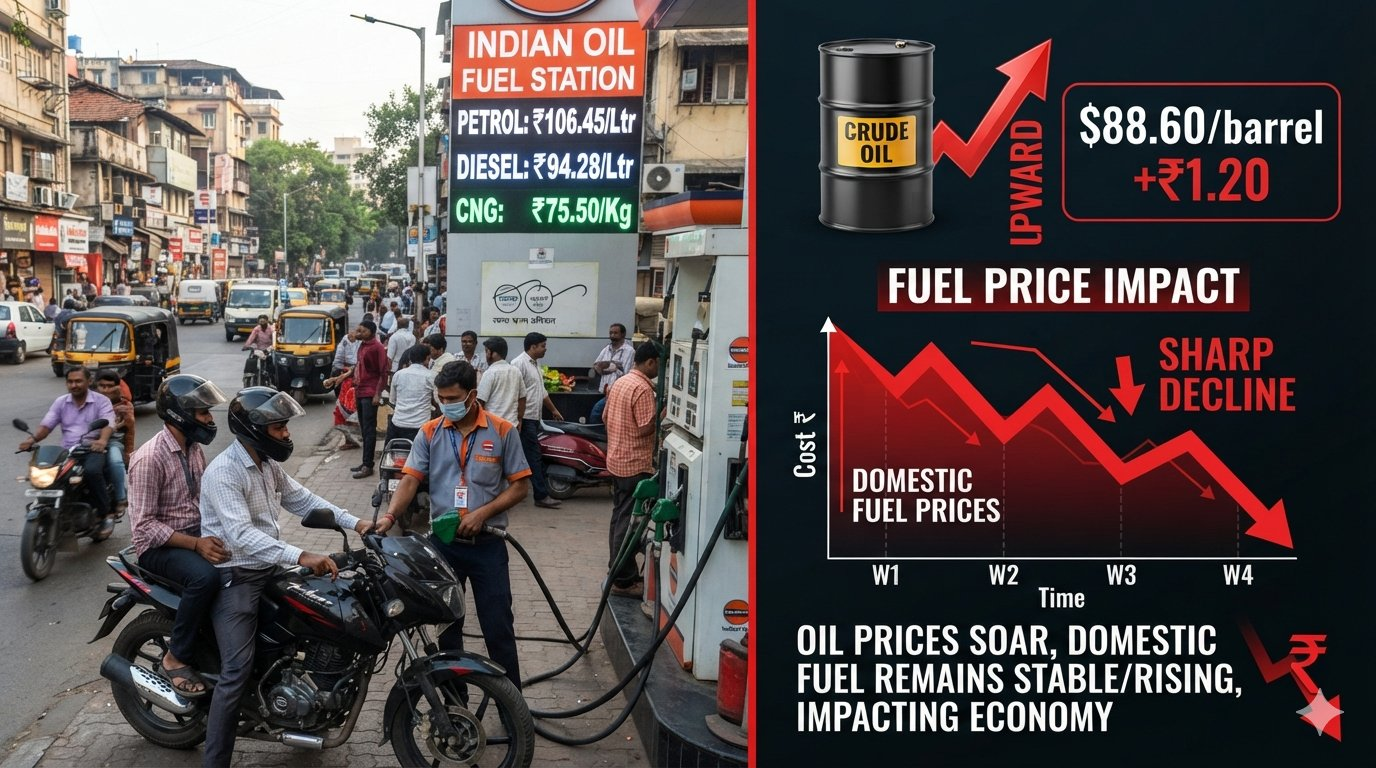
NEW DELHI — India’s state-owned oil marketing companies (OMCs) are facing a severe margin squeeze, with rating agency ICRA estimating that fuel retailers are currently losing approximately ₹5 per litre on petrol and ₹23 per litre on diesel.
This financial strain comes as a sharp resurgence in global crude oil prices collides with the government’s decision to keep domestic retail fuel prices frozen.
The root of the crisis lies in the recent geopolitical turbulence, which has driven the international benchmark Brent crude back above the psychologically critical $100-per-barrel mark.
Concurrently, the Indian crude basket has surged to roughly $109 per barrel, its highest level since late May.
However, at the pump, consumers have seen no corresponding price revision, leaving OMCs to absorb the widening gap between international procurement costs and domestic selling prices.
According to ICRA’s latest assessment, the negative marketing margins are already exerting significant pressure on the balance sheets of Indian Oil Corporation (IOC), Bharat Petroleum Corporation Ltd (BPCL), and Hindustan Petroleum Corporation Ltd (HPCL).
The agency notes that domestic liquefied petroleum gas (LPG) cylinders are also bleeding, accumulating an under-recovery of approximately ₹200 per cylinder.
This is not the first time OMCs have shouldered the burden of macroeconomic stability. During the peak of previous global supply shocks, state fuel retailers routinely absorbed daily under-recoveries exceeding ₹1,000 crore to shield domestic consumers from inflationary spirals.
However, industry insiders warn that the current trajectory is increasingly unsustainable if global hostilities persist and crude prices remain elevated over an extended period.
The reluctance to pass on the cost to consumers is politically and economically calculated. With inflation remaining a sensitive macroeconomic indicator, any hike in fuel prices would have a cascading effect on transportation costs, core inflation, and overall consumer sentiment. Yet, the longer retail prices remain static, the heavier the toll on the refining and marketing divisions of these state-run giants.
While refining margins have historically provided a buffer for OMCs during periods of weak marketing margins, a sustained period of negative fuel marketing margins threatens to erode overall profitability.
Analysts point out that unless the government authorizes a calibrated price adjustment or introduces targeted fiscal subsidies, the accumulated under-recoveries will inevitably reflect in the upcoming quarterly earnings reports of IOC, BPCL, and HPCL.
For now, the OMCs remain in a holding pattern. They are effectively subsidizing the national economy at the expense of their own bottom lines, betting that global crude volatility will cool down before the financial strain becomes untenable. But as ICRA’s stark per-litre loss figures demonstrate, the clock is ticking on how long this pricing freeze can be maintained.
Latest




Top stories


Russia News






India Business News





