
Beyond Sanctions: BRICS Leverages Critical Minerals and Food Security to Redefine Global Trade
NEW DELHI — As unilateral sanctions, escalating tariffs, and weaponized trade restrictions increasingly fracture the global economic order, the BRICS bloc is executing a strategic pivot toward profound self-reliance. At the 2026 BRICS Summit in New Delhi, member nations formalized a comprehensive framework to fortify their collective supply chains in three critical domains: energy, food security, and rare earth minerals.
 - Editor
Last Updated:
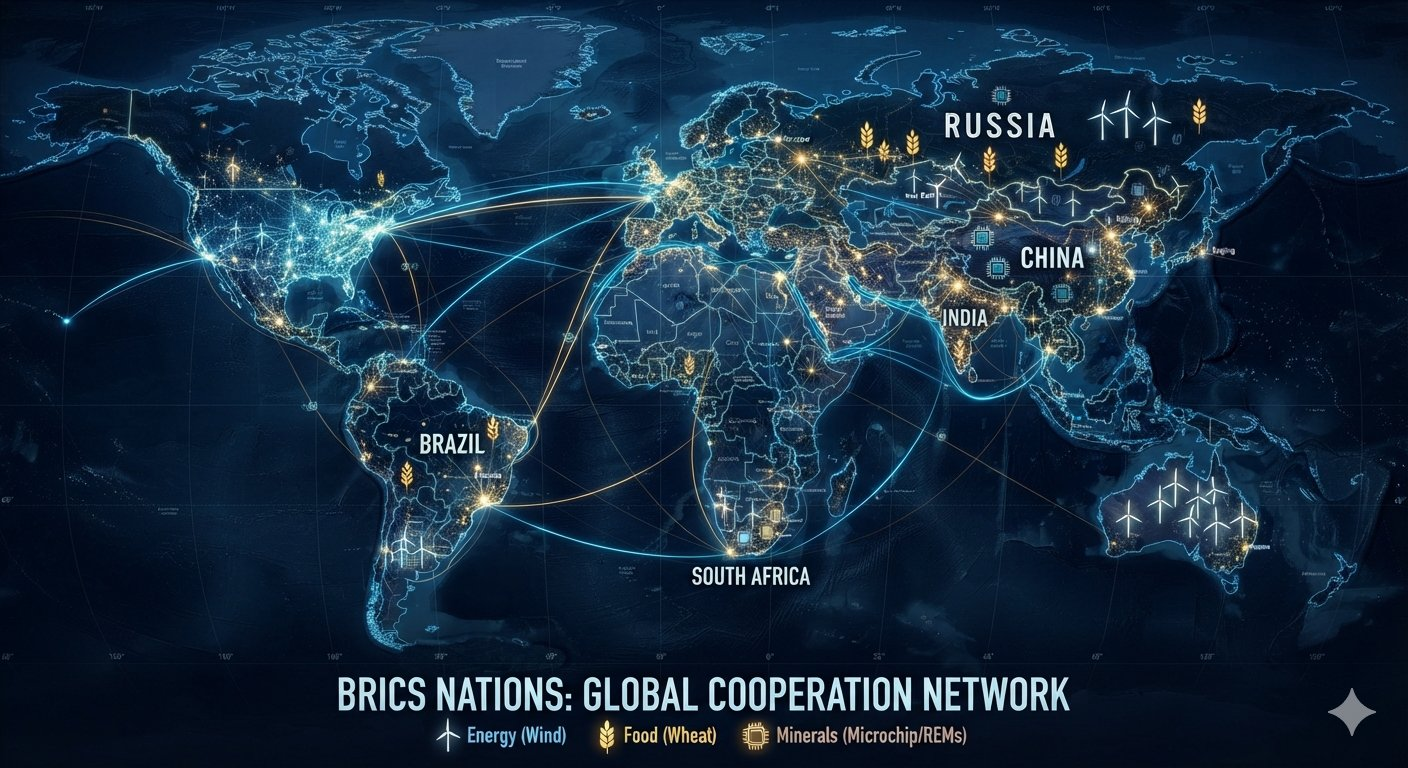
NEW DELHI — As unilateral sanctions, escalating tariffs, and weaponized trade restrictions increasingly fracture the global economic order, the BRICS bloc is executing a strategic pivot toward profound self-reliance. At the 2026 BRICS Summit in New Delhi, member nations formalized a comprehensive framework to fortify their collective supply chains in three critical domains: energy, food security, and rare earth minerals.
This coordinated push is not merely a defensive reaction to Western economic statecraft; it is a proactive recalibration of global resource governance. With the expanded BRICS alliance now commanding an estimated 42% of global oil and gas reserves and a staggering 72% of the world’s rare-earth metal deposits, the bloc possesses the raw leverage to rewrite the rules of international trade.
Prime Minister Narendra Modi underscored this vulnerability during his opening remarks, issuing a stark warning against the "weaponisation of technology and critical minerals," noting that such practices threaten to stifle global growth and destabilize emerging economies.
In response, the newly adopted New Delhi Declaration explicitly calls for the creation of resilient, demand-driven supply chains that bypass traditional, Western-dominated financial and logistical chokepoints.
In the energy sector, the focus has shifted from mere extraction to integrated, localized value chains. The bloc is accelerating the use of local currencies for bilateral energy trade, effectively insulating member states from the volatility of the US dollar and the reach of secondary sanctions.
Furthermore, initiatives like the BRICS Youth Energy Summit and the proposed BRICS Science and Research Repository aim to foster indigenous technological innovation in renewable energy and smart grid management.
Food security has emerged as an equally vital pillar of this self-reliance strategy. Recognizing that climate volatility and export bans can be deployed as geopolitical tools, India has taken the lead in operationalizing the BRICS Agricultural Research Platform.
This initiative is designed to share climate-resilient crop technologies, optimize fertilizer supply chains, and ensure that the bloc’s billions of citizens remain insulated from global food price shocks.
However, the crown jewel of the BRICS self-reliance agenda lies in critical minerals. As the global transition to electric vehicles and advanced electronics accelerates, control over lithium, cobalt, and rare earth elements has become the new geopolitical battleground.
While China currently dominates the processing of these minerals, the New Delhi consensus emphasizes the need for diversified, intra-BRICS processing hubs to prevent any single nation from holding a monopoly that could be weaponized.
"The next generation of global power will not be defined solely by military might, but by who controls the materials that power the future," noted a senior Indian trade official on the sidelines of the summit.
Challenges remain. Integrating the disparate regulatory frameworks of 11 diverse nations, from Brazil to Iran, requires unprecedented diplomatic finesse. Furthermore, building the massive infrastructure required for localized mineral processing will demand hundreds of billions in coordinated investment, much of which must be channeled through a reformed New Development Bank.
Nevertheless, the message from New Delhi is unambiguous. By pooling their vast natural resources, agricultural potential, and technological ambitions, BRICS nations are constructing an economic fortress. In an era where interdependence is increasingly viewed as a vulnerability, the bloc is betting that collective self-reliance is the ultimate shield against the uncertainties of a fragmenting world order.
Latest



Top stories






Russia News






India Business News





