



Beyond Geopolitics, BRICS Leaders Should Score with Football Cup Proposal
NEW DELHI — As BRICS leaders convene in India's capital, discussions will center on multipolarity, trade, and reforming global institutions. But there's a surprisingly powerful tool for South-South cooperation sitting on the sidelines: football. The proposal for a BRICS Cup represents more than sporting spectacle—it addresses the same inequalities in global football governance that BRICS was created to challenge in geopolitics.
NEW DELHI — As BRICS leaders convene in India's capital, discussions will center on multipolarity, trade, and reforming global institutions. But there's a surprisingly powerful tool for South-South cooperation sitting on the sidelines: football.
The proposal for a BRICS Cup represents more than sporting spectacle—it addresses the same inequalities in global football governance that BRICS was created to challenge in geopolitics.
The Football Paradox
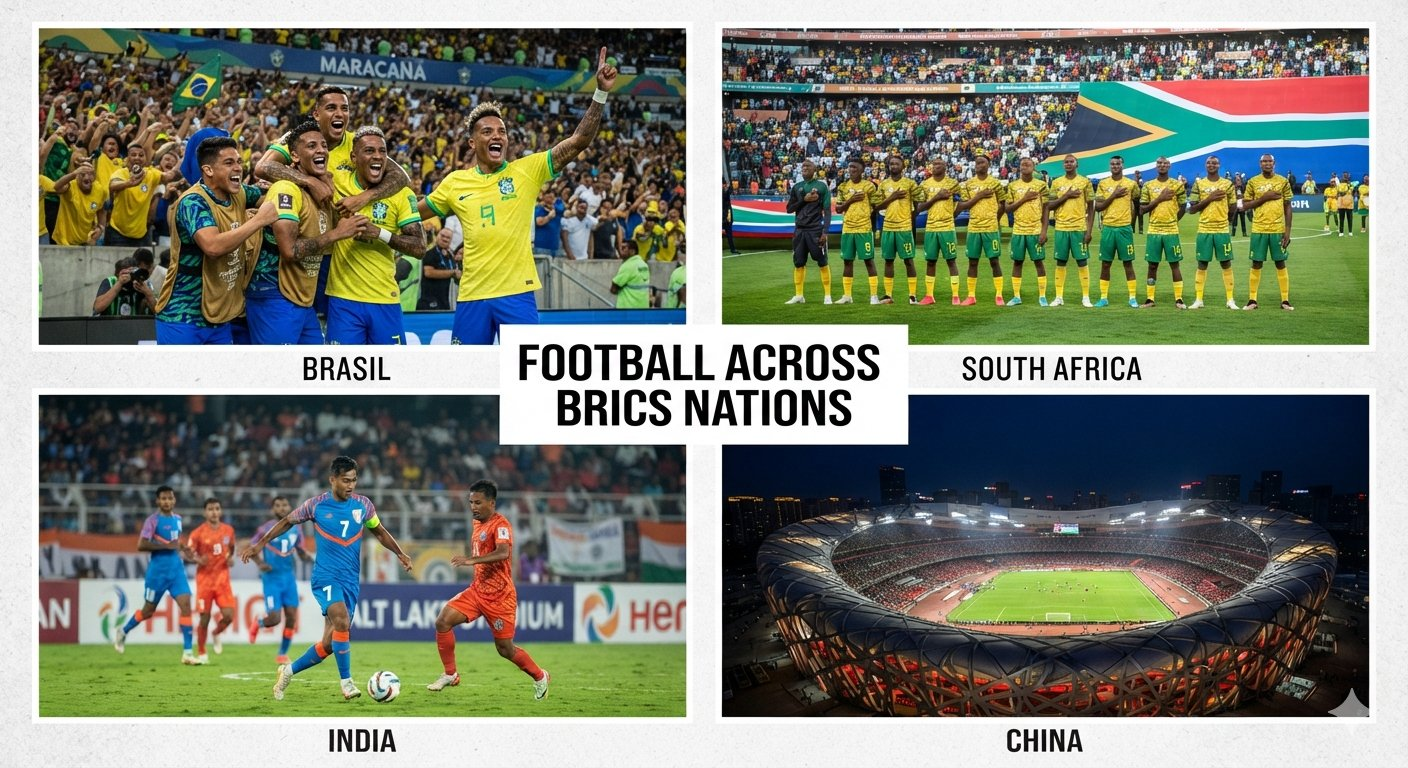
Consider the extraordinary diversity within BRICS. Brazil stands as football's undisputed superpower. Egypt and South Africa represent a continent brimming with talent. Iran maintains regular World Cup presence. Indonesia commands a massive, passionate audience.
Then there are China and India—two of the world's most consequential emerging powers. China competes with advanced economies in technology and infrastructure. India dominates digital innovation and space exploration. Yet on the football pitch, geopolitical status counts for nothing.
China has long harbored ambitions of football greatness, speaking of creating competitive teams and hosting World Cups. Yet football stubbornly resists China's otherwise remarkable catch-up capacity. India's predicament proves even more frustrating. Kolkata, Goa, Kerala, and the Northeast possess deep footballing traditions. Millions follow European club football passionately. Yet India's international record remains disappointing.
The Brazil-India Dilemma
Recent controversy over a proposed Brazil-India exhibition match in Kolkata illustrates the problem. Former Indian captain Bhaichung Bhutia questioned spending tens of crores on bringing Brazil for ninety minutes when grassroots football desperately needs resources.
The criticism proves legitimate. But it points toward a better solution. Instead of periodically spending enormous sums for a single glamour match, why not create an institution where India plays Brazil regularly because both belong to the same grouping?
A BRICS Cup makes this possible. Imagine annual tournaments rotating among member nations: Brazil versus India in Delhi, Egypt versus China in Cairo, South Africa versus Iran in Johannesburg, Saudi Arabia versus Indonesia in Jakarta.
FIFA's Governance Crisis
Deeper reasons justify the proposal. BRICS consistently questions whether institutions created under earlier power distributions adequately represent today's world. Football shouldn't escape that conversation.
FIFA faces repeated controversies over governance, commercialization, and power distribution. Most recently, the proposed FIFA Forward Enterprise—potentially bringing private investors into entities controlling valuable commercial rights—generated fierce opposition. UEFA warned against selling football's soul, and FIFA abandoned the proposal.
The larger lesson matters: who governs football, controls revenues, obtains opportunities, and receives money flows are questions of global governance.
Africa's Football Paradox
This particularly affects Africa. Nobody doubts the continent's extraordinary talent. African players prove integral to Europe's greatest clubs. Yet African national teams historically struggle to translate talent into equivalent success and influence at international football's highest levels.
Controversies reinforce perceptions of unequal treatment. After Morocco's historic 2022 World Cup semi-final against France, the Moroccan federation formally complained to FIFA about refereeing decisions. Ghana's heartbreaking 2010 exit against Uruguay remains deeply embedded in African football consciousness.
Brian Weseela, a Kenyan sports governance expert, argues: "In the Global South, the economic challenges of sport and examples of poor governance are much more visible than in the Global North. The lack of qualified professional sports leaders and the corruption in the Global South is quite evident."
South-South Football Cooperation
There's certainly room for a football institution where Global South countries enjoy greater ownership, visibility, and voice. It could complement existing international football while doing something FIFA competitions cannot—deliberately using football as an instrument of South-South cooperation and development.
The idea should extend beyond one annual men's tournament. A broader BRICS Football Partnership could include women's and under-20 competitions, exchanges between coaches and referees, sports-science collaborations, and youth-development programs.
Most importantly, part of the tournament's commercial revenues could finance a BRICS Football Development Fund. Instead of spending crores merely to buy ninety minutes of Brazilian glamour, use Brazilian excellence to help build Indian football. Broadcasting and sponsorship revenues could support youth academies, women's football, coach development, and grassroots infrastructure across member countries.
Democracy on the Pitch
There's something wonderfully democratic about football that BRICS diplomacy could leverage. Around a summit table, China is an economic superpower, India a demographic giant, Russia a military power, and Saudi Arabia an energy powerhouse. On a football pitch, none of that matters.
China cannot manufacture its way past Brazil's midfield. India's population provides no additional goals. Oil reserves cannot stop a penalty. For ninety minutes, power must be earned differently.
Existing BRICS Sports Cooperation
The proposal builds on existing foundations. The BRICS U-17 Football Cup has operated since 2016, rotating among member nations.
Russia has proposed a BRICS International Football League featuring professional clubs from member countries.
The BRICS Games 2024 in Kazan featured football alongside other sports.
bricskazan2024.games
Under India's 2026 BRICS chairship, sports cooperation has gained prominence. BRICS Sports Ministers adopted a Joint Declaration in Visakhapatnam, reaffirming commitment to sports cooperation.
India has proposed BRICS Traditional and Indigenous Sports Demonstration Games for October 2026 in Ahmedabad.
People-to-People Cooperation
BRICS spends considerable time discussing people-to-people cooperation. Few initiatives could make that phrase more tangible than millions of Brazilians, Indians, Chinese, Egyptians, South Africans, Iranians, and Indonesians watching their countries compete.
Weseela emphasizes: "We need more cooperation across countries in the Global South. The Colombian research on the structure and governance of sport may also be of interest to African countries instead of always looking at what is going on in the big international sports organisations like FIFA."
Building Institutions, Not Just Demanding Reform
BRICS wants to demonstrate that the emerging world can create institutions rather than merely demand reform of existing ones. Here's an easy place to start.
Let Brazil bring the football. Let China and India bring their ambition. Let Africa bring its extraordinary talent. Let others bring their traditions, supporters, and resources. And then let them play.
The BRICS Cup represents more than a tournament. It's a statement that Global South nations can build their own platforms for excellence, cooperation, and development—on their own terms.
Latest

Top stories






Russia News






India Business News





